
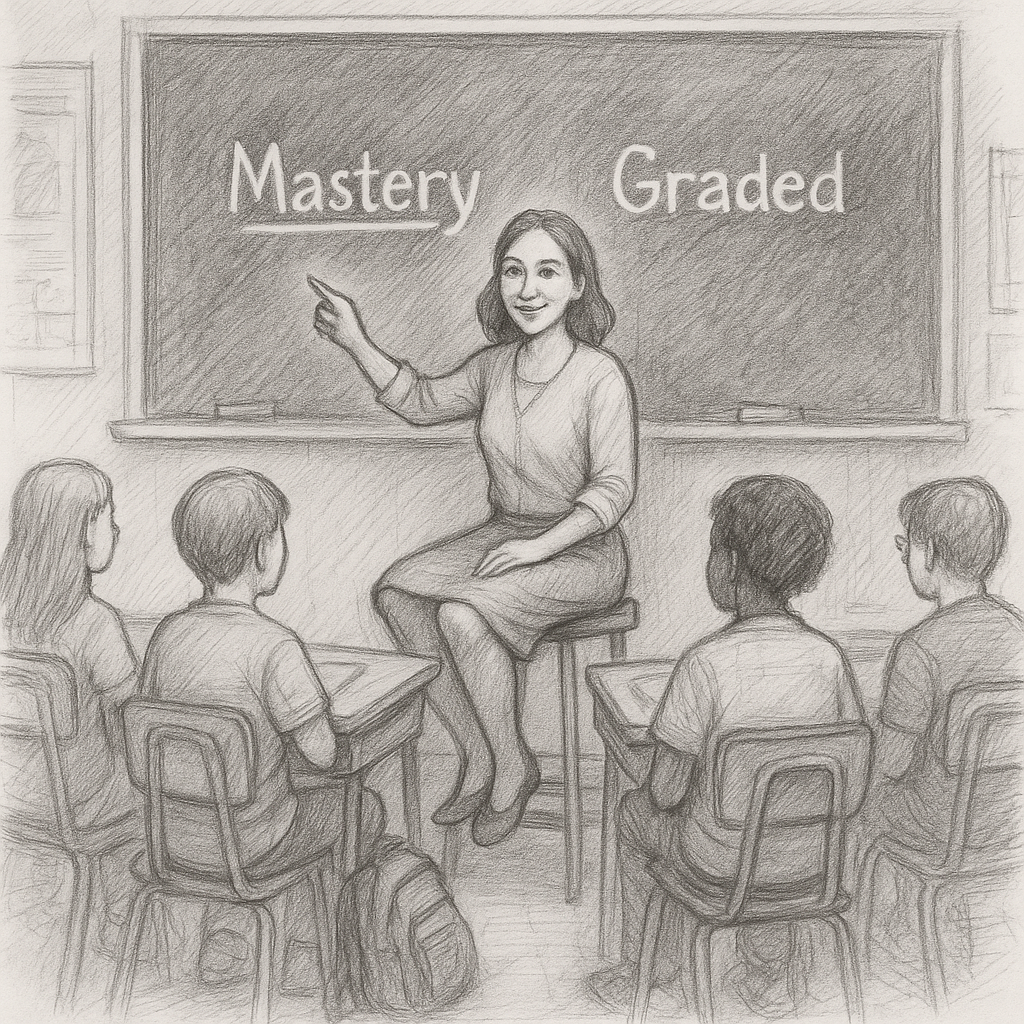
If you attended a traditional school, you were most likely on a “Graded” system such as letter grades (“A,B,C,D and F”), numeric grades (“0-100” or 4.0 system). It has been so ingrained in our schooling experience, most of us struggle to shift our thought process to any other system. If you did well in this system, you probably support that methodology. But what happens when someone presents a Mastery method that promotes learning through trial and error with less emphasis on Grades At first, you may have trouble wrapping your head around it. Afterall, grades define the progression of school and we’ve been told that this is the way we measure how much a student knows about a subject. But let’s dive a bit deeper.
Grades
Graded systems are meant to “classify” a student not to ensure that he/she learns the material. An A student is classified as the “hardest worker” or “smartest” while a D student is typically considered lazy or not very smart. The “smart” students will have more opportunities in their school career and be generally well respected by their peers and teachers. For most graded systems, there is a finite time given to the student to “learn” a piece of information whether it is homework, a project, a quiz or a test. Generally, once an item is graded, it is permanently adhered to the record. There might be extra credit or other chances to bring up the grade, but rarely are there any measures that promote another chance. This makes the class very linear with fewer opportunities to soak in the  information. Failure is bad, A’s are good. Retention is rarely fostered when assessment is only a snapshot of test-taking skills and knowledge at a single point in time. Take it a step further and an A in Algebra I in one class may not represent the same level of material/knowledge than another class offers.
Unfortunately, Teachers, Parents and Students become obsessed with this marked grade. The goal becomes the grade instead of the knowledge. Students cut corners or cheat; Parents do their kid’s projects to their children’s grades, Teachers adjust the testing to meet expectations. How many times have you heard a parent boast of their child’s “straight As” or reach out for advice because their child is barely getting by with C’s? Is there any concern about retained knowledge or quality of knowledge? Not really. Our Graded system has convinced us that this almighty Grade is the key to success.
Mastery
Mastery programs focus on the content learned. In most cases, the student has a list of things that they have to be able to demonstrate and cannot progress until they can demonstrate mastery at some level. Grades may not even exist in a Mastery Program. Failure is not a horrible word in Mastery, it is a stepping stone that informs the teacher that the student needs more help to get the material. Student doesn’t do well on an assessment, they back up and try again. The Mastery based system is geared to setting the student up for success instead of classifying them. There is more flexibility, there is generally more interaction with the teachers. In a Mastery program, the student is encouraged to master all skills/knowledge in the lesson before moving on. Parents and students often relax because they do not fear the soul-sucking ONE chance Grade.
Authentic Montessori schooling is one of the most PURE Mastery methods. Each student has a huge notebook with skills that they must master (or pass). The teacher will sit down with the student and observe whether the student has a certain level of Proficiency. This is especially helpful for subjects like Math which build on heavily on previous skills. It is also more effective to sit one-on-one with a student to identify areas that might need help. An interesting side effect is that when you focus on mastery, the class tends to also be more flexible to learning styles. Like the graded system, a mastery system may use a proficiency level to determine how well the student knows the material at any given time. The difference is that failing can be a part of the educational process instead of being a classification of the student’s value. Mastery systems generally allow the student to master the material at their own pace. Unfortunately, that can be a double edged sword for a student wanting to graduate at a certain time or a parent who is trying to encourage their student not to waste time. A lot of mastery programs are modified somewhat to fit today’s education system. They may issue final grades to appease college applications, but theoretically their class focus is on knowledge not grades.
Why does this matter?
We all want our professionals to know their stuff. We expect professionals to be competent. You choose a doctor for demonstrated expertise. When you need a specialist, you care about knowledge, experience, and skill—not a final-exam grade. So, when you put the emphasis on knowledge over grades, your child is more likely to focus on mastery even in their Grade based classes. They understand that cutting corners does not help them succeed.
Personal Experience:
We started in a traditional, private school. Almost immediately, I was annoyed at the level of worksheets, homework and projects. I could see my own child becoming very discouraged and exhausted quickly. After taking her to a psychologist, we realized that she had a visual processing issue and was extremely tactile. One of the best decisions we made was to switch her to a Montessori School and then Mastery Based Schooling. I admit that it was a bit of a shift from a graded system to a mastery based system. But we are so proud of who she became.
